
Project Showcase: Neural Evolution Simulator
3 min read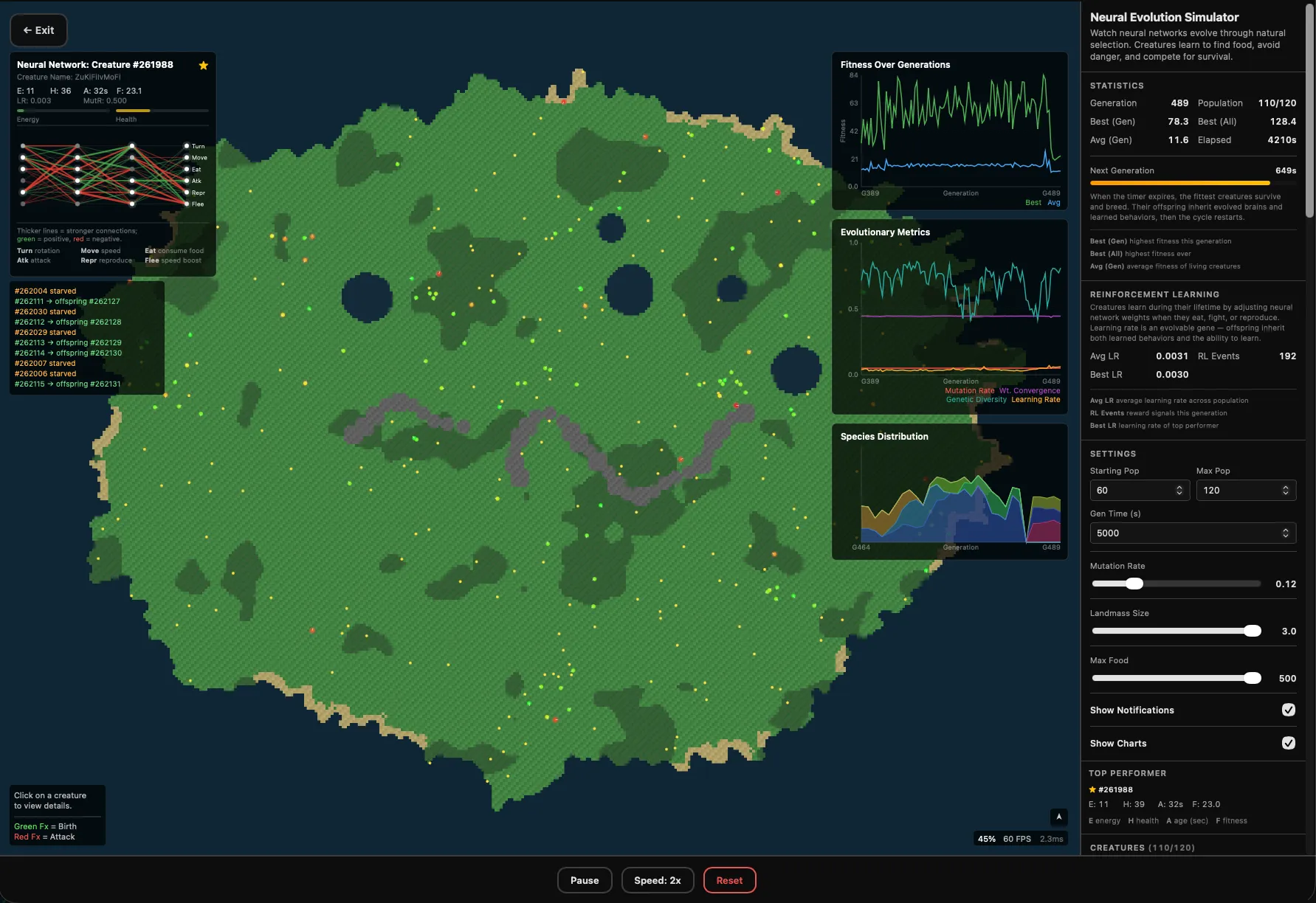
This is just a fun little project you can run in your browser, a simulated world full of hundreds of AI creatures trying to find food, survive, and learn to navigate the map. Click the “Launch Simulation” above if you want to check it out!
A Few Technical Notes On This Project
This project is an interactive browser simulation of several hundred AI “creatures” - each creature has a neural network (the network is visualized in the top left corner of the screen). The neural network is the “brain” of the creature. This brain takes in a few inputs (the “vision” of the outside world), has 2 internal layers, and has multiple possible outputs. Each creature can turn, move, eat (one of the yellow “food” dots), attack (choose to fight a nearby creature), reproduce (a creature can duplicate itself, with a cost of energy), or flee (sprint).
The neural structure of the creatures evolves over time based on “fitness” (fitness is calculated by how effectively a creature is able to navigate without getting stuck, avoid attacks from others, reproduce, eat, and survive). Over time the fitness level of the general population should increase until it hits a plateau. You can modify settings of the “map” (changing the size of the playing field, changing the amount of total food that can spawn, how many creatures can be spawned at any given time, etc.)
By changing these parameters the world becomes either easier, or more difficult to survive in (more or less food, more or less competition, etc.) - With optimal parameters (large map, lots of food, not many competitors), the fitness and intelligence of the creatures can rise quickly.
I’ve run this simulation for multiple hours, and the behaviors that arise from even simple neural nets are quite interesting. On some runs the creatures deviate towards pacifism (they completely stop attacking each other). On some runs the creatures choose not to reproduce and instead just keep eating food and running around until the next generation resets. And on other runs the creatures become hostile and frequently attack others in order to have more food available. The structure of the neural network is quite small, but with hundreds of creatures on the screen, all interacting with each other, some fairly complex and interesting behaviors sometimes arise.
Aside from the performance, the neural networks/reinforcement learning, and the fancy charts that update in real time, this project also has a few other nifty features. It fully supports mobile devices (screen size + touch input); this simulation works in both a desktop and mobile browser. Smartphone browsers are far less forgiving than desktop browsers, so there might be some performance hiccups, but it works well on all the devices I tested with.
This simulation also features an “auto save” feature, every few seconds the simulation captures the entire state of the world (all creatures, neural networks, positions, settings/parameters you’ve changed, etc.), so when you refresh the page it picks up where you left off.
Anyway that’s all I’ve got, thanks for checking out my project!